Product
Product manifesto
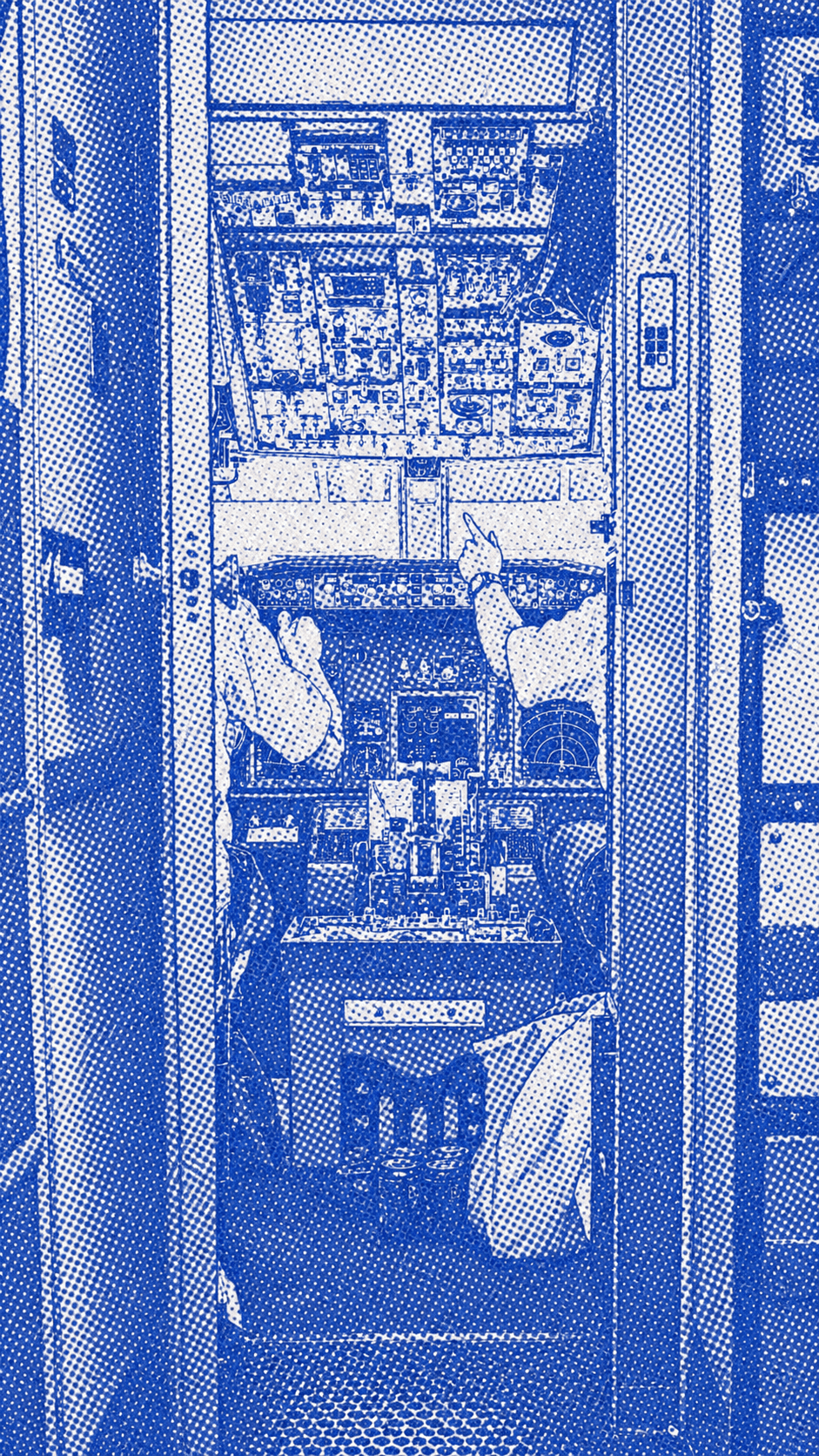
Why aviation got skipped
Historically, the best software talent and capital went into the verticals where the margins were high and the feedback loops were short.
Aviation has neither of those. Airlines run on single-digit net margins. IATA puts 2025 at a 3.7% net profit margin, around $7.20 of net profit per passenger flown. Compare that with the software categories where AI has actually flowed into and found a strong footing: legal, dev tools, and sales & marketing software often run at 70–85% gross margins before operating costs. The math is just easier there, so why bother?
When it comes to technology adoption, you can read the lag in the timelines:
Autopilot. Lawrence Sperry demonstrated it mid-flight in Paris in 1914 by climbing out onto the wing. The first transatlantic flight fully controlled by autopilot followed in 1947. Autopilot moved from early demonstrations to broad commercial adoption over decades, not years. Roughly forty years from working prototype to fully deployed technology.
Paperless cockpits. Airbus introduced "Less Paper in the Cockpit" on the A340 in the early 1990s. Paper remained a prevalent form of information in commercial cockpits for another two decades, until the iPad arrived. By 2013, American Airlines became the first major carrier to fly fully paperless. About twenty years from concept to operational deployment at a major airline scale.
That is the pattern. Aviation has historically moved slowly on software, even when the value is obvious and the safety case is achievable. It can do better. Especially now, when AI lets you build on top of legacy systems instead of ripping them out.
That is why we are building Wingman — an aviation-grade AI assistant built for real airline operations. Aviation has constraints that very few other industries face: regulations, certification cycles, integration with legacy systems, to name a few. Our thesis is that operational software can still move fast, while being safe, within those constraints. And every airline deployment gives us another proof point.
What we are actually building
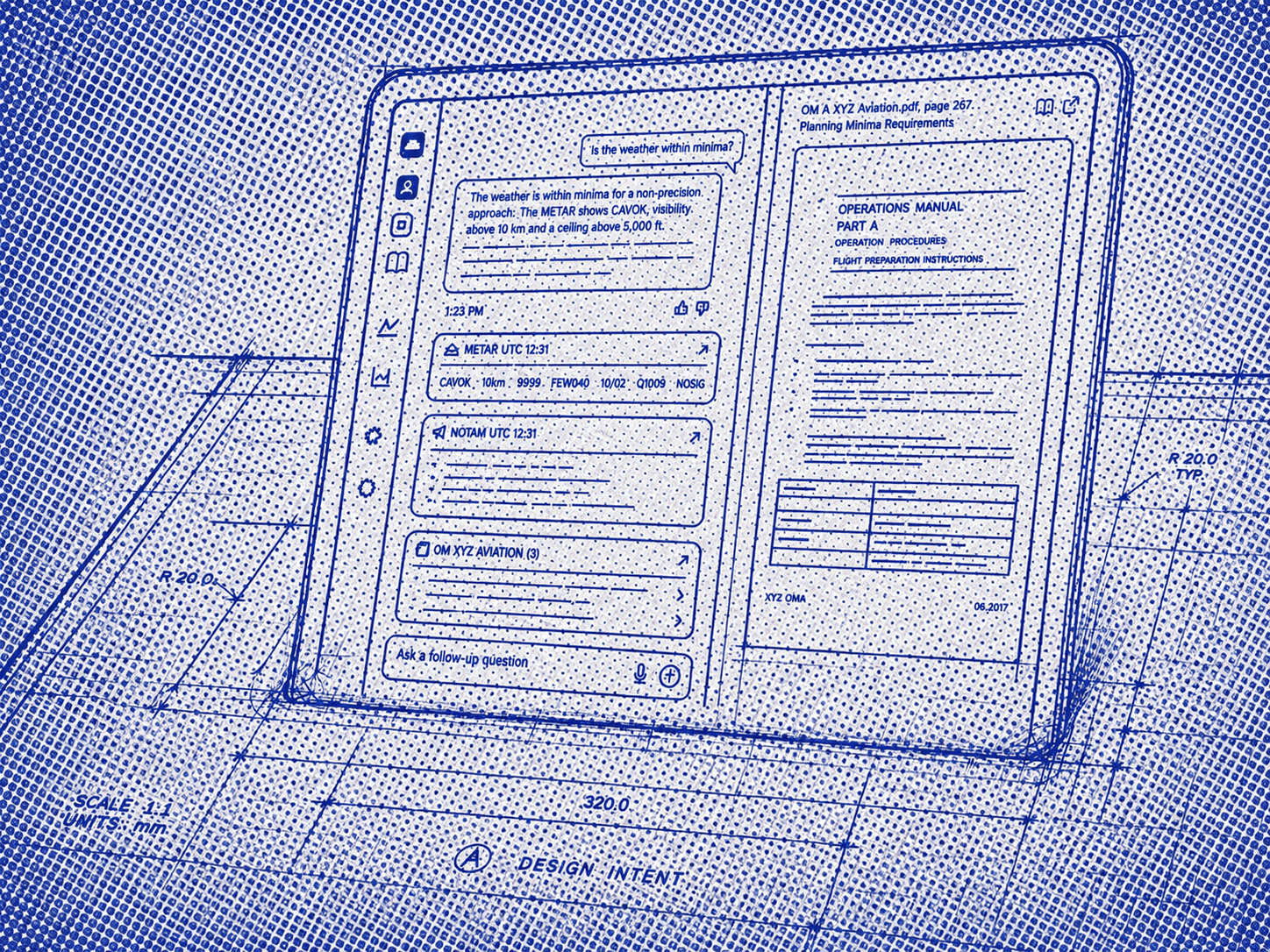
What does it actually take to build an AI assistant for aviation ops? How should it behave, what should it show, and where should it stay quiet?
Our product is being shaped every day, and a lot of it is yet to evolve. We run experiments, follow paths that lead nowhere, and throw away a lot of code and ideas.
What stays constant are the tenets we will not compromise on:
Evaluations above all. We run evaluations on every part of the system. At the heart of what we build is an evaluation framework, fed by thousands of questions pulled from real production deployments, that scores accuracy, hallucination rate, latency, and 10+ other metrics. It runs across development and production systems, and every change clears our internal evaluation bar before making it to users.
Ground truth, always. To deliver a truly useful AI assistant, we have to make every customer's content AI-ready. In practice, that means we process 10,000+ pages so they are searchable, retrievable, and digestible by our system. Every answer points back to the source, with the retrieval path and support evidence visible.
AI needs aviation-grade tooling. There is no off-the-shelf tool layer that lets an AI agent safely work with live and legacy aviation sources. So we are building it ourselves: a service that cleans, evaluates, and serves live operational data as deterministic tools for our agents. The model can change, but the system underneath will stay stable.
Interfaces that earn their pixels. In aviation apps, the information density is immense — every pixel of the user interface has to fight for its existence. We have designed more than 30 design principles drawn from aviation AI regulation, general AI governance frameworks, human factors research, and our own field observations from live operations.
Fast inference where and when it matters most. Answering thousands of questions at the same time, like when everyone opens Wingman at the start of a Monday morning shift, is not a trivial ask. While there are plenty of inference providers, guaranteeing throughput at peak demand, with predictable latency and uptime, is extremely hard. To control the user experience end-to-end, we are building the Overwatch Inference Cloud that balances demand and cost, while keeping latency predictable.
The path ahead
AI is to software what the jet engine was to aviation. It's the single biggest technological shift in a generation, and it’s already here, just not equally distributed. Wingman is our attempt to even it up and bring AI into aviation ops in months, not decades.